Solo Plumber vs. Multi-Location Contractor: 8 Ways to Size a Virtual Receptionist
A virtual receptionist that fits a solo plumber won't fit a multi location contractor, and buying the wrong size costs you either missed calls or wasted money. The good news: sizing a virtual receptionist comes down to a handful of numbers you already know, like your call volume, your average job value, and how many of your calls come in while you're under a sink or up a ladder. This article runs the side-by-side for every option, live hire, national answering service, virtual receptionist, and AI receptionist, priced against the real call volumes of Central Texas trades, so you can make the call without sitting through a sales demo.
Here are eight sizing checks that tell you which option matches your operation in 2026, whether you're a one-truck plumber in Pflugerville or running crews out of Round Rock and Georgetown.
1. Sizing a Virtual Receptionist: Start With Your Missed-Call Math, Not the Monthly Price
The right question is not "what does a virtual receptionist cost per month" but "what does a missed call cost per month." A solo plumber missing 10 calls a month at a $350 average ticket is leaving an estimated $3,500 on the table, before counting recurring customer lifetime value. A pest control owner knows this pain in a different shape: a missed first call isn't one job, it's a weekly or monthly contract worth five times a one-time visit.
Speed matters as much as the answer itself. According to MIT Sloan School of Management / InsideSales.com, the odds of contacting a lead drop 100-fold, and the odds of qualifying that lead drop 21-fold, when the callback happens at 30 minutes instead of within 5 minutes. For emergency trades, a burst pipe caller who hits voicemail is dialing the next plumber on Google within 60 seconds, not waiting for your callback.
Run your own numbers first:
- Calls per month you currently miss (check your phone log; most owners undercount by half)
- Average job value for a one-time ticket
- Lifetime value for a recurring customer (weekly lawn, quarterly pest, annual plumbing membership)
- Percentage of calls arriving after-hours (for pest control, 40% of calls land after hours is a common pattern across the industry)
Those four numbers decide your size category before any vendor pitch does.
2. Know the Four Options and What Each Actually Costs
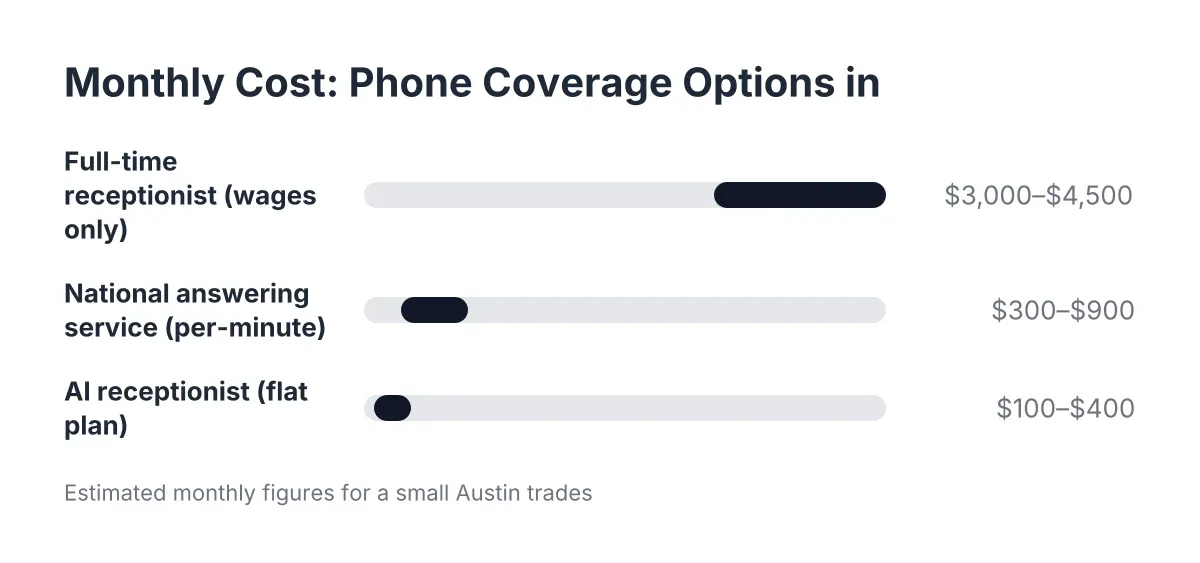
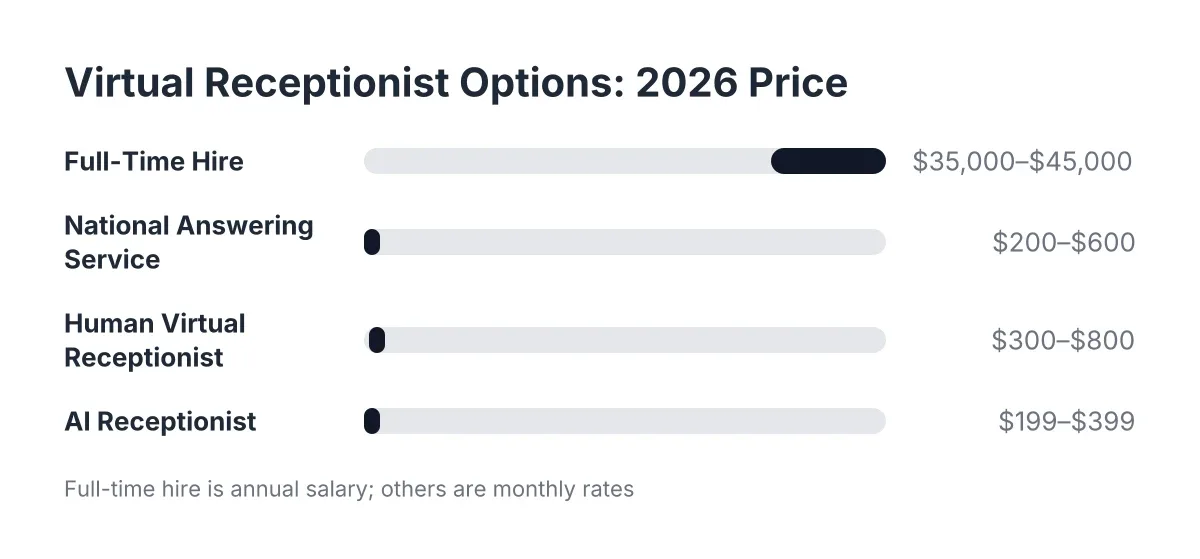
Virtual receptionist services break into four real options, and they are not interchangeable. Here is the honest 2026 price landscape, framed as typical estimates rather than quotes:
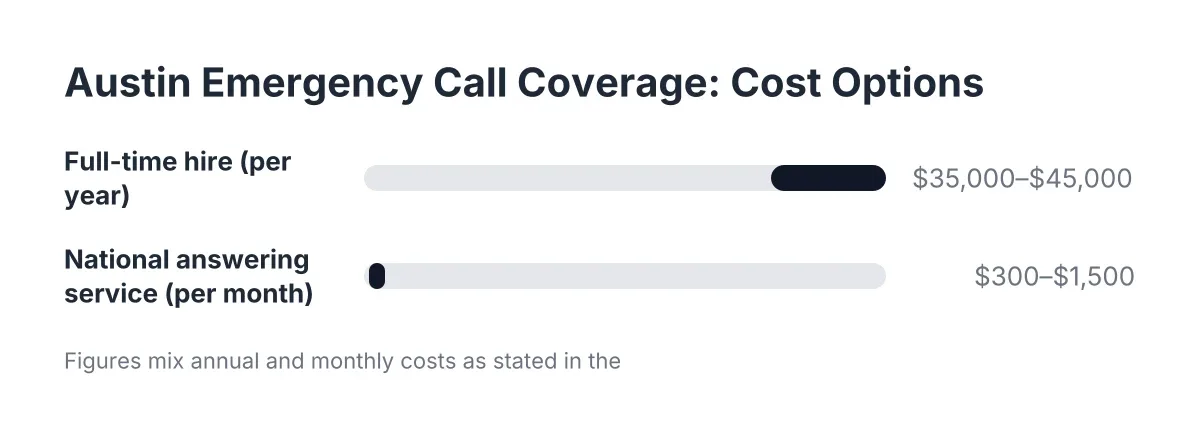
- Full-time hire: $35,000 to $45,000 a year in salary in the Austin market, plus payroll taxes and the fact that one person covers 40 hours out of a 168-hour week. Nights, weekends, and lunch breaks still go to voicemail.
- National answering service: Often $1 to $2 per minute or $200 to $600 a month for limited minutes. Operators read a generic script, don't know Cedar Park from Cedar Rapids, and typically take a message rather than book a job.
- Human virtual receptionist: Usually $300 to $800 a month for business-hours coverage with per-minute overage charges. Better than voicemail, but costs scale painfully with call volume.
- AI receptionist: Typically $199 to $399 a month flat, answering 24/7, handling lead capture, qualification, and booking on every call, in English and Spanish, without per-minute surprises.
The pattern to notice: human options price by time, AI prices by capability. That distinction drives everything in the sizing sections below.
3. Sizing a Virtual Receptionist for the Solo Plumber: Coverage Beats Capacity
A solo operator doesn't need five lines answered at once; you need one line answered every time, especially the 6 a.m. water heater call and the 9 p.m. slab leak. Your bottleneck is coverage hours, not simultaneous capacity, which is why a full-time hire is the worst fit: you'd pay a full salary for 24% of the week's hours.
Suppose you're a solo plumber in Leander and are sizing a virtual receptionist for after-hours calls. You're on site elbow-deep in a repipe when three calls come in: a warranty question, a Spanish-speaking homeowner with a running toilet, and a genuine emergency, water pouring through a ceiling. A national answering service takes three messages. An AI receptionist answers all three, books the toilet job, logs the warranty question in a summary, and, if you've opted into live transfer, bridges the ceiling emergency straight to your phone.
For solo operators, the sizing checklist is short: 24/7 answering, bilingual support if your customer base needs it, booking rather than message-taking, and emergency triage you can trust. A flat $199 to $399 monthly plan covers all of it at a fraction of one recovered job per month.
4. Sizing From Solo Plumber to Multi Location: What Changes at Scale
The jump from solo plumber to multi location contractor changes the problem from coverage to routing. One truck needs every call answered; three locations need every call answered, tagged to the right service area, and routed to the right crew or calendar. Volume also compounds: a solo operator might field 150 calls a month, while a three-location operation can see 600 or more, with simultaneous calls during storm weeks.
However, this is where honesty about fit matters. An AI receptionist handles simultaneous calls without hold music, which no single human hire can do. But multi location operations beyond a single market, say Austin plus Fort Worth plus Houston with separate dispatch rules per city, add complexity that a locally focused service may not be built for. A single-market AI receptionist shines across Austin, Round Rock, Cedar Park, Georgetown, Pflugerville, and Leander; a national five-state franchise probably needs enterprise-grade routing and should evaluate accordingly.
The practical sizing rule: if your locations share one market and one brand, AI sizing works like solo sizing with higher volume. If your locations span markets with different dispatch logic, get a professional walkthrough of routing before you commit to any option.
5. How a Virtual Receptionist Handles Incoming Calls
A virtual receptionist answers your calls using your business name, your greeting, and your qualifying questions, then either books the job, takes a message, or transfers the call based on rules you set. Human versions follow a written script; AI versions follow a trained conversation flow that adapts to what the caller says.
The difference shows up in the details. A human virtual receptionist working business hours puts your 7 p.m. caller into voicemail. An AI receptionist answers at 7 p.m., 2 a.m., and during the Sunday of a hard freeze, asks the same qualifying questions every time, and sends a booking link while the caller is still motivated. Modern systems also score and summarize each call, so Monday morning you see which leads are hot without replaying recordings.
Consumers already expect this. According to Five9, 84% of consumers know companies use AI for customer service. The same Five9 survey found 75% still prefer talking to a human, which is why the better AI setups include opt-in live transfer: routine calls get booked automatically, and urgent ones bridge to you or your office manager in real time.
6. Match Bilingual Capability to Your Customer Base, Not the Brochure
In Central Texas, bilingual answering is a sizing requirement, not a nice-to-have. A meaningful share of Austin-area emergency calls come in Spanish, and a receptionist option that can't take them is effectively smaller than its price suggests. The sizing question: what happens on your line when the caller opens in Spanish?
The options differ sharply here. A full-time bilingual hire commands a premium in the Austin labor market. National answering services often charge extra for Spanish coverage or route those calls to a separate, slower queue. An AI receptionist built for this market handles English and Spanish on every call and every plan, which means a Spanish-speaking homeowner in Pflugerville with a backed-up main gets booked as fast as anyone else.
For recurring service businesses, this compounds. A Spanish-speaking household that gets answered in their language on the first call becomes a recurring customer; one that hits an English-only voicemail becomes someone else's contract.
7. Weigh Setup Time and Switching Cost Before Committing
Hiring takes four to eight weeks of posting, interviewing, and training; a national answering service takes a week or two of scripting; a well-built AI receptionist typically goes live in days because it trains on your services, service area, and booking rules rather than onboarding a person. For a solo plumber heading into busy season, that timeline difference is itself a sizing factor.
Setup worry keeps a lot of owners on voicemail longer than it should. The NFIB's Small Business and Technology Survey found only 24% of small employers currently use AI tools, which means most of your competitors are still letting after-hours calls ring out. The same NFIB research found 98% of small employers using AI reported no change in employee headcount, which matches how trades actually use it: the AI answers and captures, the humans run the jobs and the relationships.
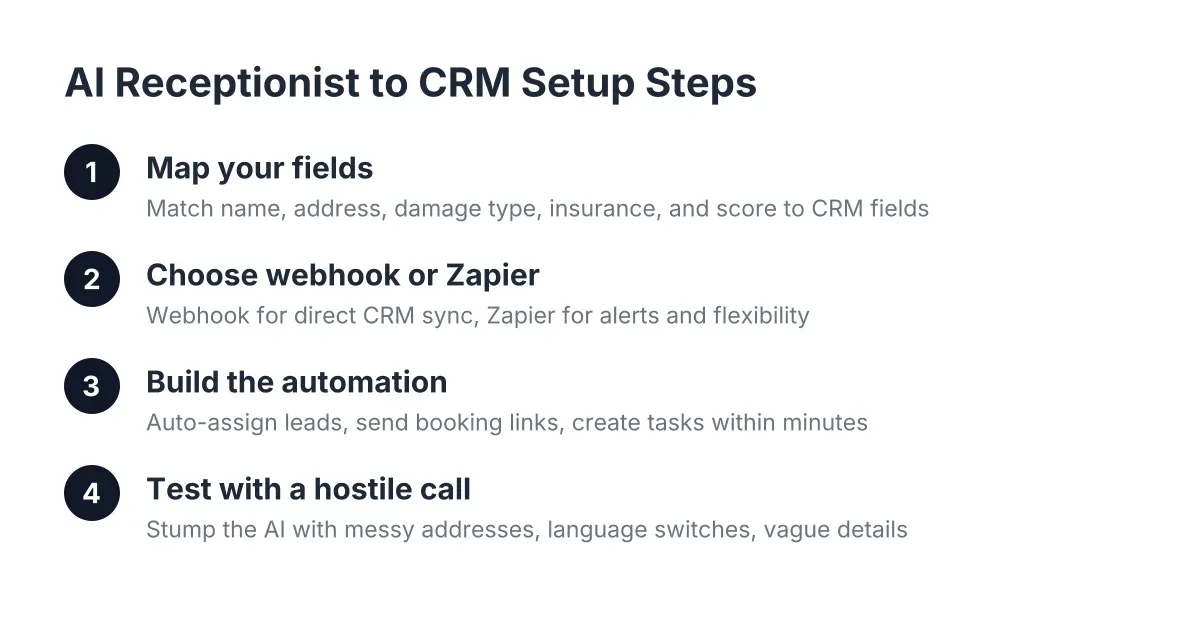
Check integration while you're at it. If you run a CRM, confirm the option can sync leads via webhooks or tools like Zapier, HubSpot, Salesforce, or Zoho, so a captured lead lands in your pipeline instead of in a notepad.
8. Run the Side-by-Side for Your Size Category
Pull it together with one honest comparison. For a solo or small-crew operation in the $200K to $500K revenue range, here is how the four options stack up on the factors that decide jobs:
- Coverage: Full-time hire covers 40 hours; answering service and AI cover 168. After-hours is where emergency trades win or lose.
- Booking vs. messages: A hire and an AI receptionist book jobs; most national services take messages, which restarts the callback race you already lost once.
- Simultaneous calls: Only AI answers three callers at once. This matters most for multi location operations and storm-week spikes.
- Local knowledge: A local hire and a locally built AI know Georgetown from Pflugerville; a national call center reads whatever the script says.
- Monthly cost: Roughly $3,000+ for a hire, $200 to $600 with overage risk for national services, $300 to $800 for human virtual coverage, $199 to $399 flat for AI, all as illustrative 2026 estimates.
For the solo plumber, the AI receptionist wins on coverage per dollar; nothing else answers 2 a.m. for under $400 a month. For a single-market multi location contractor, it wins on simultaneous capacity and consistent qualification across branches. The trade-off to accept: AI handles the first call and the booking, but it augments your customer relationships rather than carrying them; renewals, upsells, and tricky disputes still belong to you and your team.
The Sizing Decision in One Paragraph
Count your missed calls, multiply by job value, and add the lifetime value of every recurring customer who called once and never called back. If that number beats $400 a month, and for most Central Texas emergency trades it beats it several times over, you've outgrown voicemail, and probably outgrown message-taking services too. Whether you size as a solo plumber or a multi location operation, the test is the same: call the option you're considering, in English and in Spanish, at 9 p.m., and see whether it books the job or takes a message. The one that books is the one sized right.
If you're losing revenue to missed calls, NeverMiss ATX can help.
Prefer to talk it through? Call (512) 980-9267 — a quick call is usually the fastest way to get a straight answer for your situation.